


Only Mine
Gourmet chocolate manufacturer.
View case study


Once a hospitality business expands across multiple venues, central kitchens, warehouses or sales channels, purchasing, production and inventory become far harder to coordinate. Supply’d connects demand, stock, production and fulfilment across the group, replacing fragmented spreadsheets and venue-by-venue processes with one operational view.

Supply’d ERP connects venue demand, purchasing, receiving, central production, inventory, transfers and fulfilment across the group. Ingredients and finished products remain traceable as they move between kitchens, warehouses, venues, retail stores and wholesale customers, giving your team clearer planning and stronger control over cost, waste and food safety.


Supply’d ERP connects venue demand with central purchasing, commissary production, inventory, transfers and wholesale fulfilment. Production requirements become visible before shortages occur, stock updates as work happens, and every ingredient and finished product remains connected as it moves across the group.


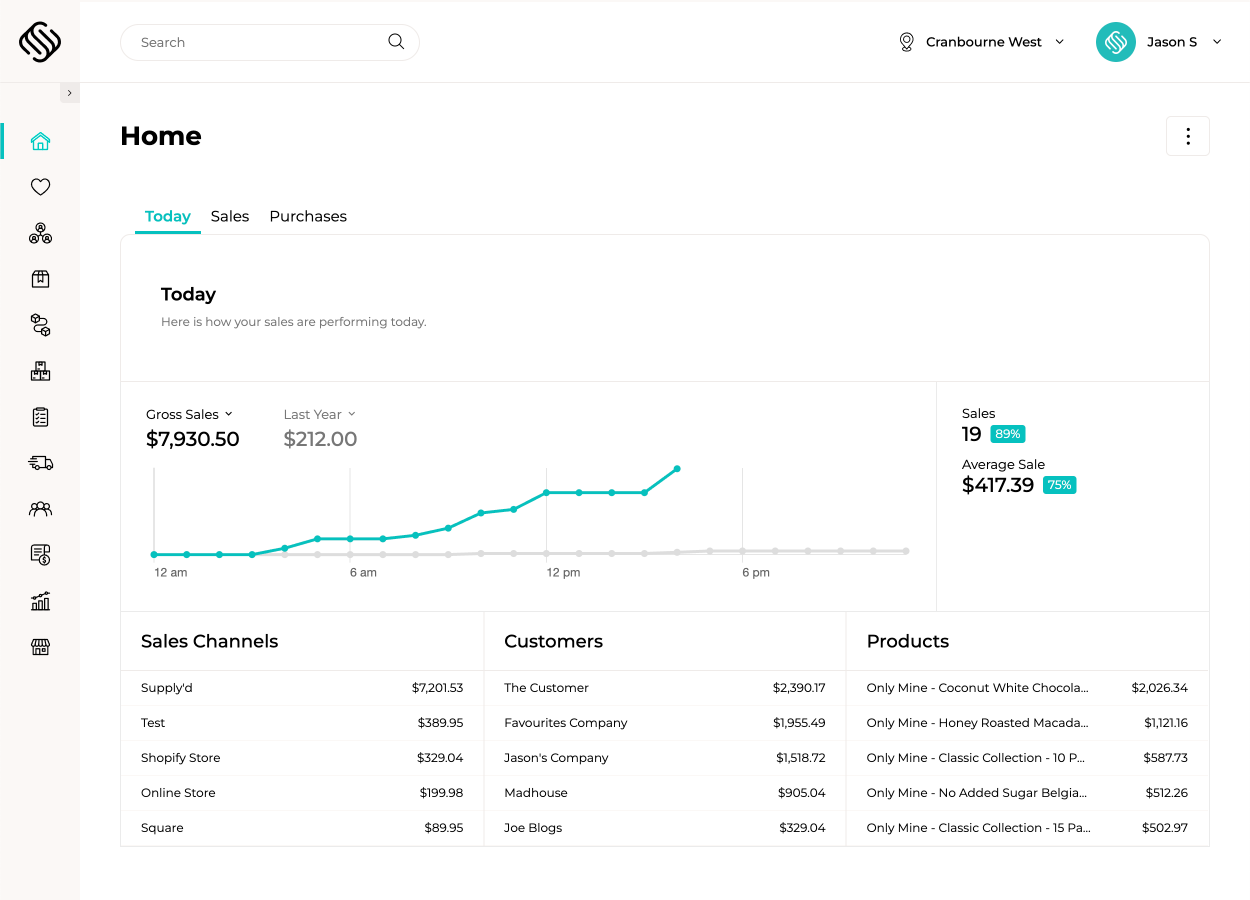
Supply’d ERP brings purchasing, central production, inventory, venue supply, wholesale and reporting into one connected platform, giving every team the information and workflows it needs to keep sites supplied, maintain traceability and protect margin.

Bring venue requirements, forecasts, standing orders and wholesale demand into one connected production plan. Supply’d helps commissary teams understand what needs to be made, when each site requires it and which ingredients must be purchased, while maintaining visibility across kitchens, warehouses and venues.
Explore Production ManagementTrack ingredients, prepared products and packaging across central kitchens, venues and storage areas. Receive deliveries, transfer stock, complete stocktakes and manage write-offs using supported scanners, with batch and expiry information retained throughout.
Explore Warehouse ManagementRecord ingredient batches, expiry dates, food-safety checks, temperatures, corrective actions and finished-product movements across production and fulfilment. Supply’d keeps those records connected for operational reviews, customer enquiries and recalls.
Explore Quality ManagementSeparate material, labour and overhead costs, compare expected and actual yield, and record waste across central production and venue supply. Supply’d helps teams understand how supplier pricing, production performance, transfers and write-offs affect the profitability of products, venues and sales channels.
Explore Business IntelligenceIf the group sells sauces, baked goods, coffee, ready meals, packaged products or other wholesale lines, customers can use Supply’d Lite to order using their own products, pricing and rules. Orders flow directly into Supply’d ERP without manual re-entry.
Explore Purchase ManagementRun venue supply, wholesale customers, ecommerce and retail products from the same operational platform. Customer-specific pricing, product ranges, standing orders and order cut-offs stay connected to production, inventory, picking and delivery. Supply’d Lite gives wholesale customers a simple way to order using their own products and pricing, with orders flowing directly into Supply’d ERP without manual re-entry.
Explore Sales Order Management

Supply’d Intelligence turns operational data into action. It forecasts venue and wholesale demand, recommends purchasing, plans central production, reads supplier invoices and improves replenishment and delivery decisions across the wider group.
Explore Supply'd Intelligence
Supply’d works from receiving through the commissary kitchen, warehouse and venue-supply process. Connect scanners, scales, label printers, production tablets and mobile devices to guide receiving, weigh-up, production, stock control, transfers, picking and delivery.

Implementation is tailored to the size and complexity of your operation. Choose structured remote onboarding or deeper planning, data support, onsite training and go-live assistance through our Discovery & Implementation Program.
Explore ImplementationSupply’d ERP runs the operational backbone behind purchasing, central production, inventory, transfers and wholesale fulfilment. It can connect with supported accounting, ecommerce and point-of-sale systems, allowing venue-level systems to remain in place while the wider group gains one connected operational view.











Supply’d combines central production, purchasing, inventory, venue supply, wholesale and reporting in one connected platform. It is built for hospitality groups whose operations extend beyond a single venue, giving head office and operational teams clearer control across kitchens, sites and sales channels.

Explore how Supply’d ERP could connect purchasing, central production, inventory, venues, warehouse, retail and wholesale across your group.
Book a demoSupply'd is primarily designed for hospitality businesses with operational complexity beyond a single venue. This may include multiple sites, a central commissary kitchen, warehouses, retail stores, wholesale products or ecommerce channels. It is not intended to be a simple recipe-costing or venue-management tool.
Yes. Supply'd supports multiple venues, kitchens, warehouses, departments and inventory locations within one connected platform. Head office can maintain central visibility while individual sites manage the workflows, inventory and tasks relevant to them.
Yes. Supply'd supports recipes, sub-recipes, production planning, batch production, guided weigh-up, labour capture, yield analysis and finished-product inventory for commissary kitchens supplying multiple venues or channels.
Yes. Venue requirements, standing orders, forecasts, wholesale demand and current inventory can be brought together to recommend what the central kitchen needs to produce. This gives production teams a clearer plan before work begins.
Yes. Venue requirements can be entered or generated through connected ordering and planning workflows. Supply'd can then consolidate those requirements into purchasing, production, transfer and fulfilment tasks for the central operation.
Yes. Supply'd can centralise supplier products, pricing, lead times, minimum orders, quantity multiples and purchasing rules. Smart Purchasing considers demand, production requirements and current inventory to recommend what should be ordered across the group.
Yes. Supply'd supports recipes, sub-recipes and multi-stage production. Sauces, fillings, doughs, stocks, bases and other intermediate products can be produced as their own batches and then consumed in finished products while costs, allergens and traceability remain connected.
Yes. Guided weigh-up workflows can step staff through each ingredient and required quantity. Supply'd can also connect with supported Wedderburn scales to reduce manual entry and capture actual ingredient usage more accurately.
Yes. Supply'd can separately track material, labour and overhead costs and compare expected yield with the quantity actually produced. This helps teams understand how production performance, supplier pricing and waste affect product and group profitability.
Yes. Supply'd tracks inventory as it is received, produced, transferred, consumed, written off and fulfilled across the group. Teams can see where stock is held and which venue, production or wholesale requirements need it.
Yes. Ingredients, finished products and operational supplies can be picked, transferred or delivered from central kitchens and warehouses to individual venues. Supply'd records what each site requires, what was supplied and where stock moved.
Yes. Supply'd supports scanner-based receiving, stocktakes, transfers, guided picking, packing and batch selection. Teams can record work directly in the warehouse or central kitchen while inventory updates as tasks are completed.
Yes. Supplier batches and expiry dates can be recorded during receiving and followed through inventory, production, transfers and fulfilment. This helps teams maintain traceability across central kitchens, warehouses, venues and wholesale customers.
Yes. Digital checks and recurring tasks can be built into production and operational workflows. Staff can record temperatures, cleaning checks, corrective actions, metal detection results and other required information, creating a time-stamped operational record.
Yes. Supply'd can calculate allergen and nutritional information from the ingredients used in recipes. If an approved substitution is made, the resulting product information can be recalculated to reflect what was actually produced, subject to your own review and compliance requirements.
Yes. Waste, damaged stock, expiry and other write-offs can be recorded against the relevant product, batch, location or production run. This gives the business a clearer view of where stock and margin are being lost.
Yes. Hospitality groups selling coffee, sauces, baked goods, ready meals or other packaged products can manage wholesale customers, customer-specific pricing, product ranges, standing orders, picking, packing and delivery within the same platform.
Yes. Wholesale customers can use Supply'd Lite to order using their own products, pricing and ordering rules. Orders flow directly into Supply'd ERP without manual re-entry.
Yes. Venue supply, retail stores, ecommerce and wholesale operations can run within the same connected platform. Supply'd integrates with supported ecommerce and point-of-sale systems so each sales channel can draw from the same operational workflows and inventory.
Supply'd is designed to run the operational backbone behind purchasing, central production, inventory, transfers, wholesale and fulfilment. Whether your existing point-of-sale system remains in place depends on the integrations available and the scope of your implementation.
Yes. Supply'd integrates with supported platforms including Xero, MYOB, Shopify, WooCommerce and Square. Additional API or integration work may be possible where venue or group systems require a more complex connection.
Supply'd is designed to run the operational side of the group, including purchasing, production, inventory, transfers, wholesale and fulfilment. Financial information can then be sent to supported accounting platforms such as Xero and MYOB.
Yes. Locations, departments, production areas, product ranges and user permissions can be configured so teams see and manage the information relevant to their role while head office retains one connected operational view.
Supply'd is cloud-based and can be used across computers, tablets and supported mobile devices. Hospitality groups may also use PDA scanners, tablet scanners, connected scales, barcode and label printers, production tablets and delivery devices across receiving, production, transfers and fulfilment workflows.
Yes. Implementation can be phased by location, department or operational priority. A group may begin with central production and warehouse operations before expanding into venue transfers, wholesale, retail or additional sites.
Implementation can include operational discovery, product and recipe migration, supplier setup, production configuration, inventory and transfer workflows, integration planning, hardware deployment and staff training. The rollout is tailored to the structure and complexity of the group.