



Madhouse Bakehouse
All-Australian wholesale bakery.
View case study



As orders, products, locations and delivery runs grow, production planning becomes more complex, ingredient usage is harder to control and small mistakes quickly turn into waste, delays and lost margin. Supply’d brings the operation together, so your team can keep pace without relying on spreadsheets, paper and memory.

Most bakery software manages one part of the operation. Supply’d connects the entire journey, bringing wholesale orders, standing demand, production planning, ingredients, picking and delivery together in one platform. From the moment an order is received, every team can see what needs to happen next.


Supply’d ERP connects the bakery floor with the rest of the business. Customer orders inform production, recipes consume real ingredients, inventory updates as work happens and every finished product stays connected through picking, delivery and reporting.


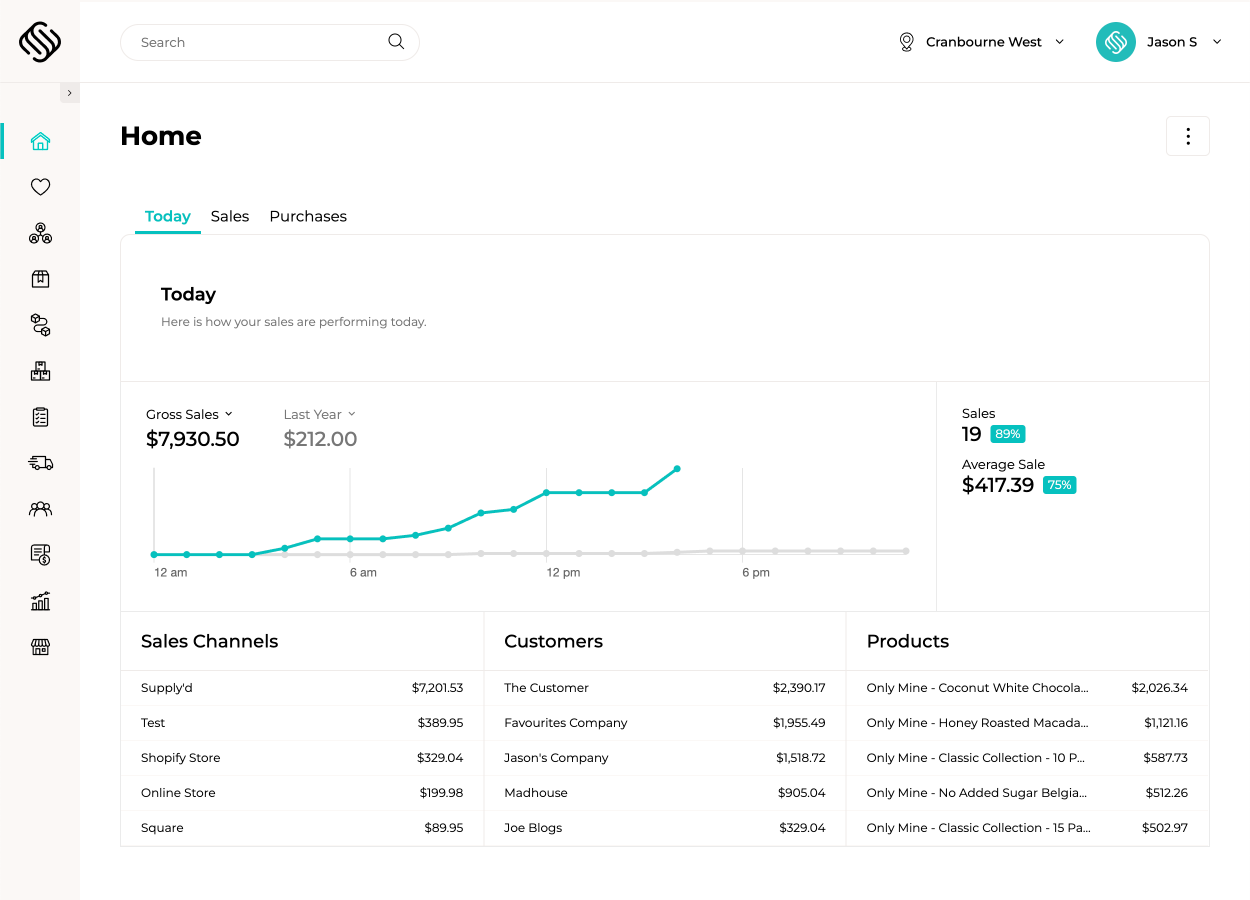
Give every team one connected way to plan demand, make products, move stock, maintain control and support growth.

Turn standing orders, forecasts and customer demand into practical production plans. Supply’d helps calculate what needs to be made, when it needs to be made and which ingredients are required, giving your team a clear plan before production begins.
Explore Production Management| NUTRITIONAL INFORMATION | ||
Build recipes using weights or baker’s percentages and manage ingredients, allergens, nutrition and specifications in one place. Generate labels and specification sheets from the same accurate product information.
Explore Product ManagementUse orders, forecasts, recipes and stock on hand to calculate ingredient and packaging requirements. Supply’d Intelligence recommends purchases around supplier lead times, minimums and order multiples.
Explore Purchase ManagementBring orders from every sales channel into one place, alongside recurring standing orders for each customer and delivery day. Manage changes without rebuilding orders, then flow confirmed demand into production planning, picking and delivery.
Explore Sales Order Management
Use a Supply’d PDA scanner to receive stock, complete stocktakes and guide picking and packing. Products remain connected to their location, batch and expiry throughout the warehouse.
Explore Warehouse Management

Supply’d Intelligence optimises delivery routes around daily orders, standing deliveries and customer requirements. Drivers can use a Supply’d PDA scanner to follow each run, view stop instructions and capture digital proof of delivery.
Explore Delivery ManagementCompare expected demand with actual production, yield, waste and sales. Supply’d helps you understand where overproduction, ingredient cost changes and production variance are affecting profitability.
Explore Business IntelligenceCapture production, allergen and finished-product checks against each batch. Schedule recurring food safety tasks and maintain training records to help teams follow the correct process across shifts and sites.
Explore Quality Management

Supply’d Intelligence turns operational data into action. It helps forecast demand, recommend purchasing, plan production, read incoming orders and invoices, and optimise delivery, all within the workflows your team already uses.
Explore Supply'd Intelligence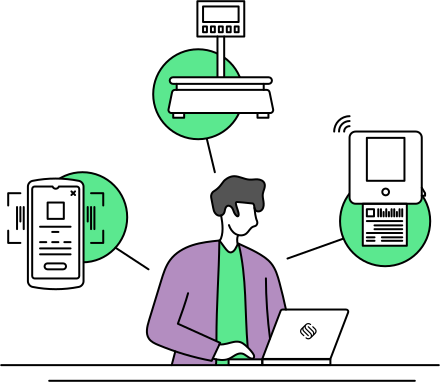
Supply’d works where the bakery work happens. Connect scanners, scales, label printers, production tablets and mobile devices to guide receiving, weigh-up, production, picking, packing and delivery.

Implementation is tailored to the size and complexity of your operation. Choose structured remote onboarding or deeper planning, data support, onsite training and go-live assistance through our Discovery & Implementation Program.
Explore ImplementationSupply’d ERP runs the operational side of your bakery, including orders, purchasing, production, inventory, fulfilment and delivery. Financial information can then flow into supported accounting platforms such as Xero and MYOB, allowing your finance team to keep its existing accounting workflow.











Supply’d combines bakery production with purchasing, inventory, wholesale ordering, warehouse, delivery and reporting in one connected system, helping growing bakeries replace manual work with clearer, repeatable workflows.

Explore how orders, ingredients, production, picking and delivery could work together in one connected platform.
Book a demoYes. Supply'd combines customer orders, standing orders, forecasts, current inventory and production requirements to recommend what needs to be made. Your team can work from a clear daily production plan instead of manually rebuilding cut lists and production sheets in spreadsheets.
Yes. Standing orders can be reviewed and adjusted through a weekly planning workflow that also considers public holidays, school holidays, forecasts and product-specific order cut-offs. This gives your team more control than simply generating the same order every week regardless of what is actually happening.
Yes. Supply'd supports product-level and customer ordering rules, allowing you to control when orders must be placed for particular products or delivery days. This helps protect production schedules without forcing every product into one universal cut-off time.
Yes. Supply'd supports traditional baker's percentages and hydration calculations, making it easier to scale formulas accurately and understand ingredient proportions. Bakers can work in familiar bakery terminology rather than forcing every formula into a generic manufacturing format.
Yes. Starters, levains, fillings, sauces, doughs and other intermediate products can be produced as their own batches and then consumed within finished products. Costs, allergens, nutrition and batch traceability remain connected through every production stage.
Yes. Guided weigh-up workflows can step staff through each ingredient and required quantity during production. Supply'd can also connect with supported Wedderburn scales, helping reduce weighing errors, standardise production and capture actual ingredient usage more accurately.
Yes. Recipes and formulas can be scaled according to the required production quantity, including configured yield multiples and production rules. This allows the same formula to be used for different production volumes without manually recalculating every ingredient.
Yes. Supply'd records the expected yield from the recipe alongside the quantity actually produced. This helps identify variation, waste, overuse and process inconsistency, while showing how production performance affects cost and margin.
Supply'd calculates recipe costs using current ingredient pricing and can separately account for materials, labour and overhead. When ingredient costs or actual production yields change, your team can see how those changes affect the cost and margin of the finished product.
Yes. Supply'd can calculate nutritional and allergen information from the ingredients used in a recipe. If an approved ingredient substitution is made during production, the resulting allergen and nutritional information can be recalculated to reflect what was actually produced. Final labels and compliance remain subject to your own review and regulatory requirements.
Yes. Supply'd can generate configurable product and batch labels, price lists and product documentation using information already held in the system. This can include ingredients, allergens, batch numbers, expiry dates, barcodes and other product information required by your operation.
Yes. Supply'd records ingredient batches and expiry dates during receiving, tracks which batches are consumed in production and connects finished-product batches to the customers who received them. A batch can then be traced from supplier through production and fulfilment for recalls, customer enquiries and audit preparation.
Yes. Digital checks and recurring tasks can be included in production and operational workflows. Staff can record temperatures, cleaning checks, metal detection results, corrective actions and other required information, creating a time-stamped digital record for your food-safety program.
Yes. Supply'd tracks batch and expiry information and can guide teams to use stock according to first-expired, first-out rules. This helps improve stock rotation, reduce avoidable waste and maintain stronger control across receiving, production and fulfilment.
Yes. Customers can use Supply'd Lite to order using their own product range, pricing and ordering rules. Orders flow directly into Supply'd ERP, reducing email, phone orders and manual entry for your sales team.
Yes. Supply'd supports customer groups, pricing tiers, customer-specific pricing and controlled product ranges. When customers order through Supply'd Lite, or when your team enters an order for them, the correct products and prices are applied automatically.
Yes. Supply'd connects finished production with warehouse picking, packing and delivery. Teams can use scanners for guided picking and packing, while delivery workflows can include route planning, proof of delivery, customer instructions and temperature records where required.
Yes. Supply'd supports multiple locations, departments, warehouses and production areas within one connected platform. A central bakery can produce for retail stores, wholesale customers or other sites while maintaining visibility over inventory, orders and production across the operation.
Supply'd is designed to run the operational side of the bakery, including purchasing, production, inventory, orders, fulfilment and delivery. Financial information can then be sent to supported accounting platforms such as Xero and MYOB, allowing your finance team to retain its existing accounting workflow.
Supply'd is cloud-based and can be used across computers, tablets and supported mobile devices. Bakery teams may also use connected scales, PDA scanners, tablet scanners, barcode and label printers, and production tablets for receiving, weigh-up, production, picking, packing and stock control.
Implementation can include operational discovery, data migration, recipe and product setup, workflow configuration, integrations, hardware setup and staff training. The process is tailored to the complexity of your bakery rather than treating every business as though it produces the same heroic loaf in the same heroic way.