

Wholefood Merchants
Australia's largest wholefood grocer.
View case study



As products, suppliers, departments and locations grow, product data becomes harder to maintain, purchasing becomes fragmented and café or prepared-food production often operates separately from the rest of the business. Supply’d connects those workflows so your team can reduce manual work and operate with clearer stock, supplier and margin visibility.

Supply’d ERP connects supplier ranging, purchasing, receiving, inventory, café production, replenishment and sales across the operation. Products and ingredients stay connected as they move through storage, production and stores, giving your team clearer stock visibility, stronger traceability and better control over waste and margin.


Supply’d ERP connects suppliers, product data, purchasing, inventory, café production, storage and stores in one system. Demand informs purchasing and replenishment, production consumes real ingredients, and stock remains visible as it moves across the operation.


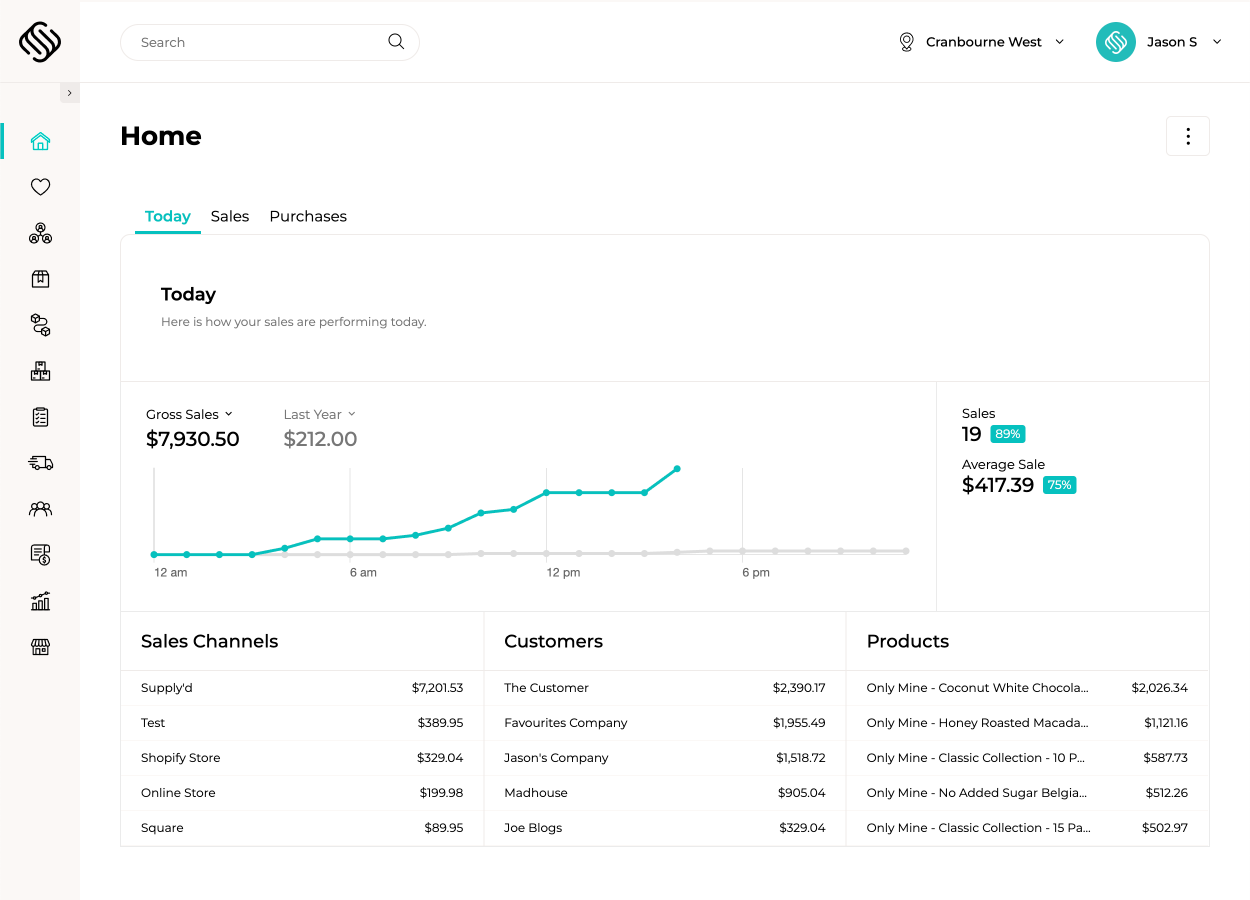
Supply’d ERP brings the work of planning, making, moving, controlling and growing into one connected platform, so every team can operate from the same source of truth.

 Connected Through Supply'd Hub
Suppliers submit products, pricing, images and promotions through Supply’d Hub. Your buying team reviews, approves or declines each submission, and approved product information flows into Supply’d ERP without being rebuilt manually.
Explore Product ManagementUse sales demand, current inventory, minimum stock, supplier lead times, order multiples and purchasing rules to recommend what should be ordered. Supply’d gives buyers clearer information while keeping them in control of reviewing and approving purchase orders.
Explore Purchase Management
Run café recipes, ready meals, salads, baked goods, juices and other prepared foods in the same system as purchasing and inventory. Ingredients are consumed as products are made, finished stock becomes available for sale, and costs, batches, allergens and expiry information remain connected.
Explore Production ManagementBuy, receive, store and sell products in different units and weights without losing control of inventory or cost. Supply’d supports bulk foods, repacking, variable-weight products, barcode workflows and scale-connected processes across receiving, production and retail operations.
Explore Warehouse Management
Capture expiry, write-offs, café production yield, supplier cost changes and sales performance across packaged, bulk and prepared products. Supply’d helps teams understand where stock and margin are being lost across the operation.
Explore Business Intelligence

Supply’d Intelligence turns operational data into action. It forecasts demand, recommends purchasing and replenishment, plans café production, reads supplier invoices and highlights changes affecting stock, waste and margin.
Explore Supply'd Intelligence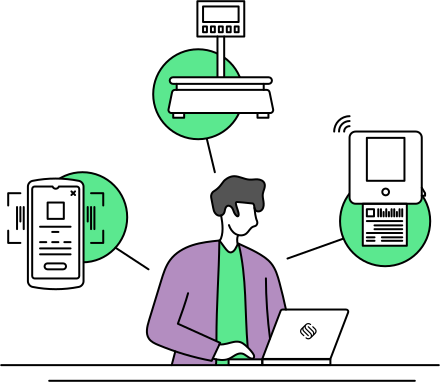
Supply’d works from the receiving area to the café and shop floor. Connect scanners, scales, label printers, tablets and mobile devices to guide receiving, stocktakes, repacking, production, transfers, replenishment and inventory control.

Implementation is tailored to the size and complexity of your operation. Choose structured remote onboarding or deeper planning, data support, onsite training and go-live assistance through our Discovery & Implementation Program.
Explore ImplementationStop wrestling with disconnected systems. Supply'd ERP acts as the central brain of your wholefood store—connecting your POS, Weighing Scales, and Accounting software into one real-time source of truth.











Supply’d combines large-catalogue retail, supplier management, bulk inventory, café production and multi-location workflows in one connected platform. That gives wholefood retailers the flexibility to manage complex products and departments without stitching together separate systems.

Explore how Supply’d ERP could connect suppliers, purchasing, inventory, bulk foods, café production, stores and reporting across your business.
Book a demoYes. Supply'd is designed to manage extensive product ranges across many suppliers, departments and locations. Products can include supplier codes, pack sizes, barcodes, pricing, images, ingredients, allergens, ordering rules and other operational information within one connected catalogue.
Yes. Suppliers can use Supply'd Hub to submit new products, pricing, images, specifications and other required information directly to your buying team. Buyers can review each submission, approve or decline it, and load approved product information into Supply'd ERP without manually recreating the product record.
Yes. Once a supplier submission is approved, the supplied product information can be used to create or update the relevant record in Supply'd ERP. This reduces duplicate data entry and helps maintain more consistent names, barcodes, pack sizes, pricing, images and specifications.
Yes. Suppliers can submit promotional offers through Supply'd Hub, while your buying team reviews the proposed products, dates and pricing inside Supply'd ERP. Approved promotions can then be connected to purchasing and supplier invoice verification, reducing manual promotion administration.
Yes. Supply'd centralises supplier products, pricing, lead times, minimum orders, order multiples and purchasing rules. Buyers can review suggested purchases, create purchase orders and manage supplier relationships without rebuilding orders across spreadsheets, emails and separate supplier portals.
Smart Purchasing considers sales demand, current inventory, minimum stock, supplier lead times, order multiples and upcoming requirements to recommend what should be ordered. Your buying team remains in control of reviewing and approving purchase orders before they are sent.
Yes. Supply'd supports products that are purchased, received, stored, repacked, produced or sold in different weights and units. Actual weights can be captured through supported workflows so inventory, costs and quantities reflect what physically moved through the operation.
Yes. Supply'd supports unit-of-measure conversions across purchasing, inventory, production and sales. For example, a product can be purchased by the bag or carton, stored by weight, repacked into smaller quantities and sold by the unit or kilogram.
Yes. Bulk goods can be repacked into smaller retail products while maintaining ingredient usage, cost, batch and expiry information. Finished products can then be labelled and made available for sale without relying on separate production or inventory records.
Yes. Supply'd supports recipes, sub-recipes and multi-stage production for café meals, salads, juices, baked products, ready meals and other prepared foods. Ingredients are consumed during production, finished inventory is created and costs, allergens, batches and expiry information remain connected.
Yes. Ingredients used by the café or kitchen can be drawn from the same purchasing and inventory system as the wider retail operation. Supply'd records what was consumed and updates inventory as production is completed, giving the business a clearer view of actual stock and product cost.
Yes. A central kitchen or production area can produce finished goods for multiple stores, departments, wholesale customers or other locations. Supply'd can connect production requirements, finished inventory and transfers across the operation.
Yes. Supply'd supports multiple stores, warehouses, departments and inventory locations within one platform. Head office and operational teams can see where stock is held, manage transfers and maintain clearer visibility across the wider business.
Yes. Stock can be received into a central warehouse, transferred between locations and replenished into stores or departments. Supply'd records inventory movements as they happen, reducing manual transfer records and improving stock visibility.
Yes. Supplier batches and expiry dates can be recorded during receiving and followed through inventory, repacking, production and fulfilment. This improves traceability and helps teams understand where expiring or affected stock is held across the business.
Yes. Supply'd can guide warehouse and production teams to use stock according to first-expired, first-out rules. This helps improve stock rotation, reduce avoidable waste and maintain stronger control over perishable inventory.
Yes. Teams can record expiry, damaged stock, production waste and other write-offs against the relevant products, batches and locations. This gives the business a clearer view of where stock and margin are being lost across packaged, bulk and prepared products.
Yes. Supply'd supports scanner-based receiving, stocktakes, inventory movements, write-offs, picking and batch selection. Teams can use supported PDA or tablet scanners to record work directly on the floor rather than relying on paper sheets or office computers.
Yes. Supply'd supports connected scale workflows through compatible Wedderburn equipment. Scales can be used across weigh-up, repacking and other weight-based workflows to reduce manual entry and improve the accuracy of recorded weights.
Yes. Supply'd can generate configurable shelf, product, batch, carton and pallet labels using information already held in the system. Labels can include product names, prices, barcodes, weights, batch numbers, expiry dates, ingredients and allergens where required.
Yes. Supply'd supports GS1 barcode workflows and can read relevant product, batch, expiry and weight information from supported barcode formats. It can also support weight- or price-embedded barcode workflows used for variable-weight products.
Yes. Wholefood businesses can manage wholesale customers, customer-specific pricing, standing orders, picking, packing and delivery alongside retail and café operations. Wholesale customers can also place orders through Supply'd Lite.
Supply'd is designed to run operational workflows such as supplier management, purchasing, inventory, production, warehouse and fulfilment. Whether your existing point-of-sale system remains in place depends on the integrations available and the scope of your implementation.
Supply'd is designed to run the operational side of the business, including purchasing, inventory, production, orders, warehouse and fulfilment. Financial information can then be sent to supported accounting platforms such as Xero and MYOB, allowing your finance team to retain its existing accounting workflow.
Yes. Departments, production areas, product ranges and user permissions can be configured so teams see and manage the information relevant to their role while the business retains one connected operational view.
Supply'd is cloud-based and can be used across computers, tablets and supported mobile devices. Wholefood teams may also use PDA scanners, tablet scanners, connected scales, barcode printers, shelf-label printers and production tablets across receiving, stocktakes, repacking, café production and warehouse workflows.
Implementation can include operational discovery, product and supplier data migration, workflow configuration, integration planning, café production setup, hardware deployment and staff training. The rollout can also be phased by department, location or operational priority where appropriate.