






Wholefood Merchants
Australia's largest wholefood grocer.
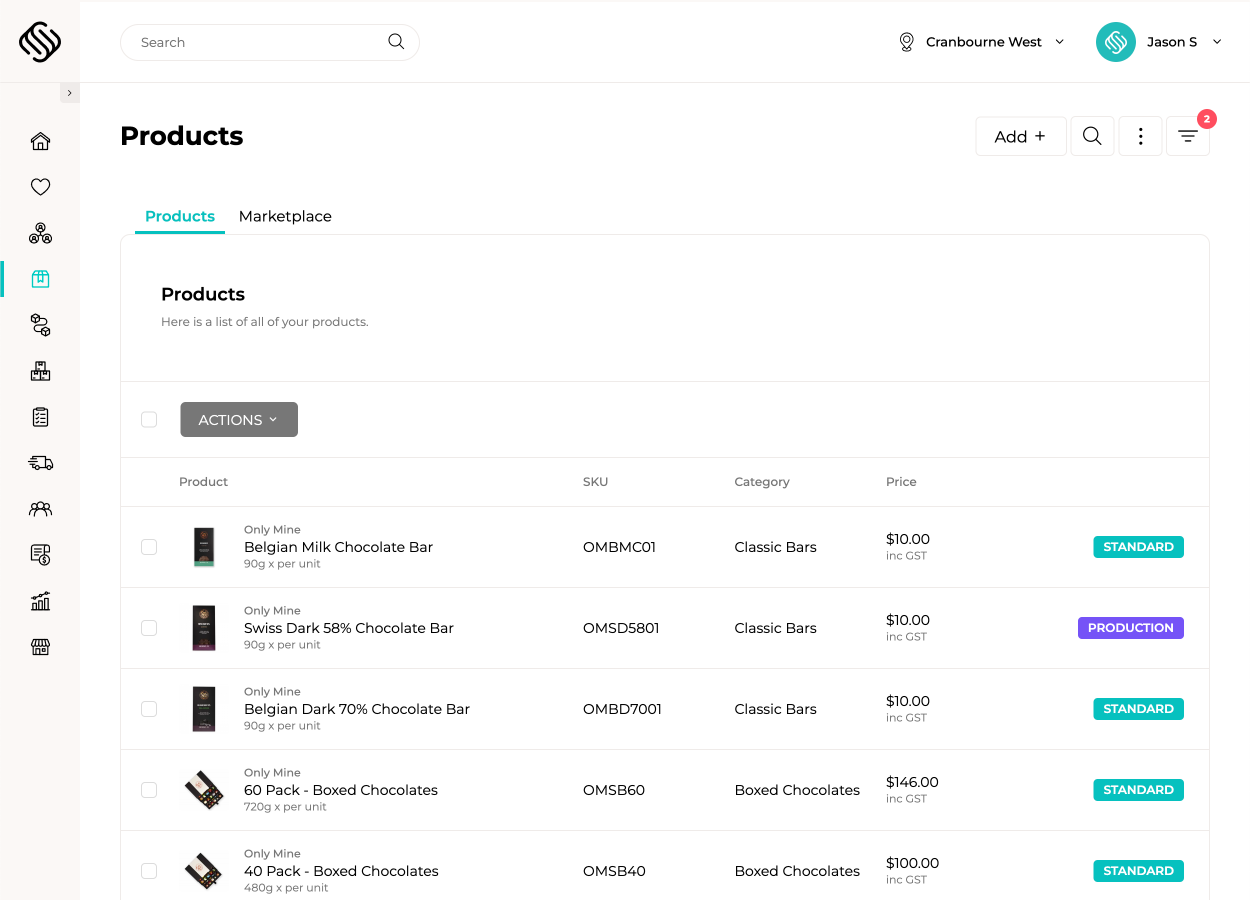
View case studyKeep product details, suppliers, pricing, units, barcodes, files and sales settings together in one central record. Manage every product from introduction to discontinuation while retaining its complete purchasing, inventory, sales and traceability history.

 Connected Through Supply'd Hub
New product requests, price changes, discontinued items and promotions should not be buried across hundreds of supplier emails. Supply’d Hub gives suppliers one place to submit complete product information and updates directly to your team, ready for review in Supply’d ERP. New products. Price changes. Discontinued lines. Promotions. All in one place.
Explore Supply'd HubChoose where each product is available and how it should be sold across wholesale, retail and ecommerce. Manage channel-specific pricing, units, descriptions and availability, with supported updates syncing to platforms such as Square, Shopify, Wedderburn and WooCommerce. Sell a product individually in-store, by carton to wholesale customers or through your ecommerce store without creating disconnected product records.
Keep supplier costs, customer pricing and promotions under control with scheduled changes, bulk updates and automatic syncing across connected sales channels. Manage different prices by customer, location or channel while maintaining clear visibility over margins as costs change.
Build recipes using ingredients, packaging, labour and production stages, with costs calculated from current purchasing information. Manage batch sizes, yields, sub-recipes, baker’s percentages and approved ingredient substitutions while separating materials, labour and overhead costs. When substitutions are made, Supply’d can automatically recalculate ingredient statements, allergens and nutritional information based on the ingredients being used.
| NUTRITIONAL INFORMATION | ||
Keep ingredients, allergens, nutritional information, shelf life, storage requirements and country of origin details connected to each product. Generate specifications directly from recipes and store supporting documents such as supplier certificates and HACCP records, helping your team maintain accurate information without juggling separate files.

Generate product and batch labels, nutritional panels, shelf tickets, recipe cards and specification sheets directly from the information already held in Supply’d. Manage unit, carton and GS1 barcodes so products can be scanned accurately through receiving, production, stocktake, picking, packing and sale.
View a complete activity history for every product, including what was changed, when it happened and who made the update. This gives your team greater control over important changes to pricing, product details, specifications and operational settings.

Explore how food manufacturers, bakeries, wholesalers and retailers use Supply’d ERP to run their operations.
Book a demoSupply’d ERP is built around the workflows food manufacturers, distributors and retailers rely on every day.
Supply’d is built around the way food and retail businesses actually operate. We combine deep industry understanding with connected technology to deliver product management software that improves control, reduces manual work and connects teams across the operation.
Product management software gives your team one place to manage product information, suppliers, pricing, promotions, recipes, specifications, barcodes and sales channels. Supply’d also connects this information with purchasing, production, inventory, sales and reporting, making it part of the wider operational workflow.
Yes. Supply'd can manage ingredients, packaging, manufactured products, retail products, wholesale products, finished goods, intermediate products, kits, hampers and bundles within the same connected platform.
Yes. Multiple suppliers can be connected to the same product, each with their own supplier SKU, purchase price, carton quantity, ordering unit, lead time, minimum order and quantity multiple.
Supply'd Hub gives suppliers one place to submit new products, price changes, discontinued items, promotions and supporting information. Your team can review these updates in Supply'd ERP instead of sorting through hundreds of emails, spreadsheets and attachments.
Yes. Suppliers can provide product descriptions, images, supplier SKUs, carton details, pricing, specifications and supporting documents through Supply'd Hub, giving your team clearer and more complete information when reviewing new products.
Yes. Current and upcoming supplier pricing can be recorded against each product. Price changes can be reviewed before they take effect, helping purchasing and accounts teams maintain accurate costs and understand the impact on margins.
Yes. Products can be discontinued or removed without deleting their purchasing, inventory, sales, costing or traceability history.
Yes. Product availability can be managed across locations, stores, departments and sales channels. This allows different sites or channels to carry different product ranges while maintaining one connected product record.
Yes. Products can be activated, scheduled, ranged or discontinued according to your operational requirements. This supports seasonal lines, limited releases, temporary ranges and products available only through selected locations or channels.
Yes. Supply'd supports customer-specific pricing, customer-group price lists, wholesale pricing, retail pricing and quantity-based pricing. Different customers can order the same product using the pricing and ordering rules assigned to them.
Yes. Products can have different prices across retail, wholesale and ecommerce channels. Pricing, units and availability can be managed for each channel without creating disconnected copies of the same product.
Yes. Future buy and sell price changes can be prepared in advance using effective dates. This allows your team to review changes before they begin and reduces the need to update products manually on the day a new price takes effect.
Yes. Promotional selling prices can be scheduled for selected products, customers, customer groups or sales channels using defined start and end dates.
Yes. Supplier promotions can be recorded with eligible products, promotional costs and active dates. Promotions are shown during purchasing, can be applied automatically to purchase orders and remain visible during expense reconciliation.
Yes. Suppliers can submit upcoming promotions through Supply'd Hub for review by businesses using Supply'd ERP. This gives purchasing teams one place to see available opportunities instead of relying on promotional emails and attachments.
Yes. Product information and pricing can be imported or updated in bulk, helping teams manage large product catalogues and widespread pricing changes without editing each product individually.
Yes. Supply'd integrates with supported platforms including Square, Shopify and WooCommerce. Depending on the integration, product information, pricing, availability, barcodes and inventory can be kept connected across sales channels.
Yes. The same product can be sold individually through retail, by carton to wholesale customers or through ecommerce using different prices, units and availability settings for each channel.
Yes. Supply'd supports recipes, sub-recipes and multi-stage production. Intermediate products such as sauces, doughs, fillings and bases can be produced as their own batches and then consumed in finished products.
Yes. Product costs can include ingredients, packaging, labour and overheads. Supply'd uses current purchasing information to help calculate expected recipe and production costs and show how supplier price changes affect margins.
Yes. Recipes can include expected batch quantities and yields, while production records can capture the quantity actually produced. This helps teams compare expected and actual output and understand the cost impact of yield variation.
Yes. Baker's percentages can be used to build and scale recipes based on the total flour weight, giving bakeries a more familiar way to manage recipe ratios and production quantities.
Yes. Approved substitutions can be configured for ingredients and selected during production. Costs, ingredient statements, allergens and nutritional information can then be recalculated based on the ingredients actually used, subject to your own review and compliance requirements.
Yes. Allergen and nutritional information can be calculated from the ingredients used within recipes. The information remains connected with the underlying product data so updates can flow through to specifications, labels and product documents.
Yes. Products can include ingredients, allergens, nutrition, shelf life, storage requirements, country of origin details, preparation instructions and supporting documents such as supplier certificates and HACCP records.
Yes. Supply'd can generate product labels, batch labels, ingredient declarations, allergen statements, nutritional panels, country of origin information and other operational labels from connected product and recipe data.
Yes. Supply'd can generate shelf tickets, recipe cards, costing documents and product specification sheets using the information already maintained against products and recipes.
Yes. Products can have separate barcodes for units and cartons, including supported GS1 formats.
Barcodes can be used across receiving, production, stocktakes, transfers, guided picking, packing and sale. This helps teams identify products accurately while completing work throughout the operation.
Yes. Supply'd maintains product activity history showing what changed, when the change occurred and which user made the update. This provides greater control over changes to pricing, specifications and operational settings.
Yes. Supply'd can use connected sales, ordering and inventory information to help identify product demand and trends. This information can support purchasing, production planning and stock management decisions.
Yes. Supply'd is designed to manage complex product catalogues across suppliers, locations, sales channels and operational workflows. Bulk imports, custom fields, categories, product groups and connected supplier information help teams manage products at scale.